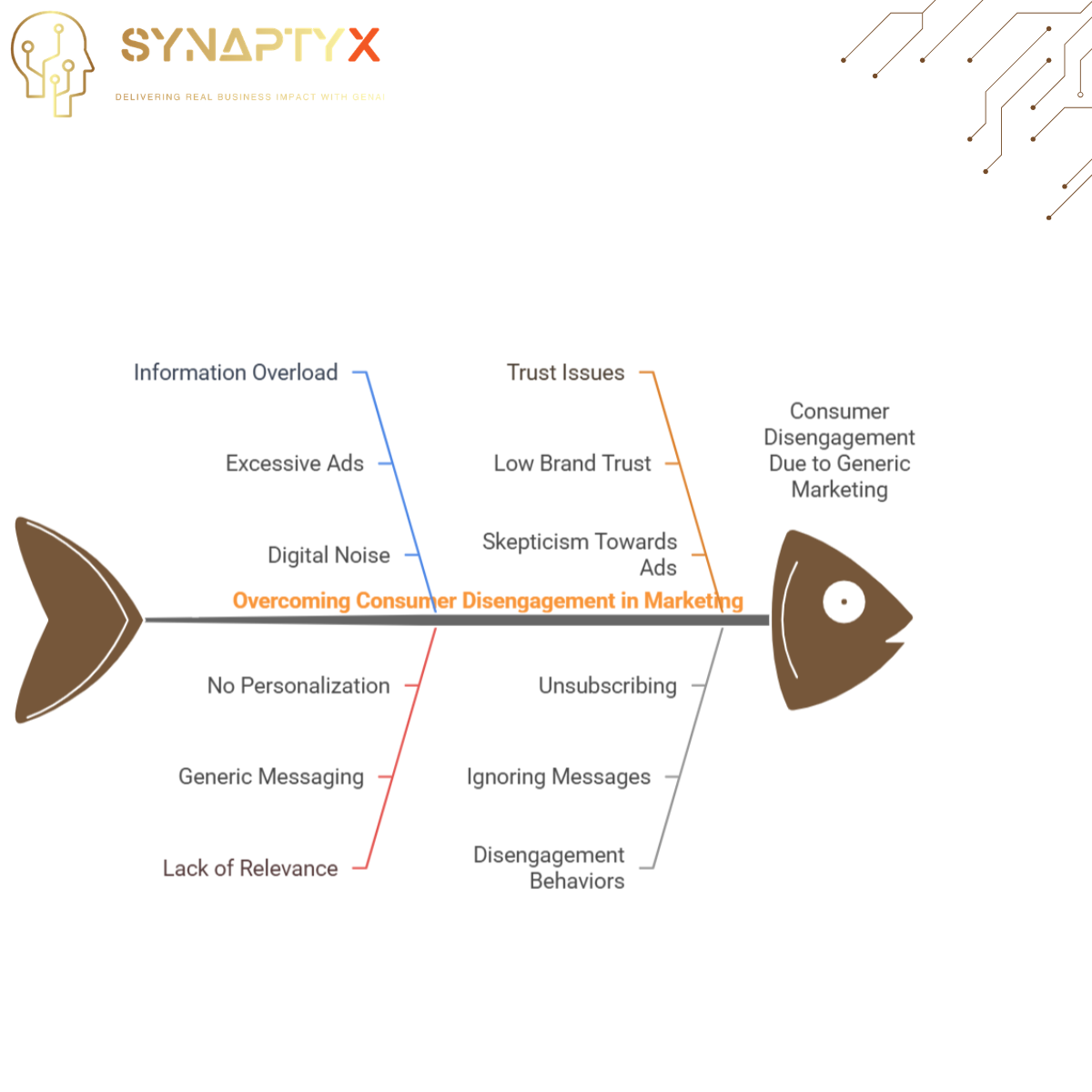
Scroll through any feed or inbox today and you'll witness a deluge of ads, promos, and brand messages all vying for attention. Consumers are bombarded – two-thirds say they want fewer marketing messages, and 27% feel utterly "bombarded" by them.
This constant noise has bred a healthy scepticism. People have learned to tune out generic ads and emails, and trust in traditional marketing is near record lows (only about half of consumers trust brand advertising). The result? Disengagement.
The classic one-size-fits-all marketing playbook – blasting the same message to as many people as possible – is failing to break through.
In an era of information overload, bombarding consumers with generic messages not only yields dwindling engagement but creates a growing disconnect between consumers and brands. Fed up with the onslaught, today's consumers are quicker than ever to ignore, unsubscribe, or outright distrust marketing that isn't relevant to them.
In response to this scepticism, many marketers have rushed to adopt the latest "hot" tactics – hopping on viral social media trends, pouring budgets into influencer campaigns, or chasing whatever platform is popular this quarter. The logic is sound: meet consumers where they are already paying attention.
Yet even these trend-based approaches are hitting a ceiling:
Consumer Sentiment Percentage
Fatigued by repetitive influencer content 47%
Influenced by celebrity endorsements to make purchases 3%
In other words, flooding Instagram with paid posts or hiring the trendiest TikTok star doesn't guarantee trust or engagement – especially if the content feels inauthentic or irrelevant. Brands that rely solely on buzz marketing often see only superficial results. The audience might notice the campaign, but they won't necessarily believe in it.
Consumers increasingly see through one-off influencer stunts or meme-driven ads when those tactics aren't backed by substance or genuine understanding of the audience. The takeaway for CMOs is clear: chasing trends is not a panacea. To truly overcome consumer suspicion, marketers must go beyond borrowed interest and build real relevance and authenticity into their strategies.
Hyper-Personalisation: Marketing to an Audience of One
If broad-brush messaging and flashy campaigns fall flat, how can brands break through the noise? The emerging answer is hyper-personalisation – treating every potential customer as a market of one, with messaging tailored explicitly to their needs and interests. Rather than one-size-fits-all, it's one-size-fits-one.
This approach uses data-driven insights to craft content and offers unique to each individual. Why is this the antidote to consumer scepticism? Because relevance breeds resonance. When a brand shows it truly "gets" a customer – by presenting solutions or stories that align with that person's preferences – the marketing stops feeling like marketing and starts feeling useful.
What Consumers Want
• 71% expect companies to deliver personalised interactions
• 76% get frustrated when they don't receive personalised experiences
• 81% open emails that are tailored to their interests
• 67% more likely to purchase when recommendations reflect past behavior
In short, generic blasts are annoying your audience, whereas personalisation is welcomed. The impact on engagement is dramatic.
When every touchpoint – from website content to emails to ads – speaks directly to an individual's needs, it cuts through the noise. The message is immediately more credible because it's relevant. Over time, these tailored interactions build trust: the consumer sees that the brand consistently provides value to them, not just blasting self-serving promotions.
Hyper-personalised marketing turns the tide from scepticism ("Ugh, another ad I don't care about") to engagement ("Hey, this brand understands what I'm looking for"). It's a strategy built on listening to the customer and crafting experiences around them, rather than expecting the customer to adapt to a blanket message.
Data and AI: The Engine Behind Personalisation
Achieving this level of personalisation for each customer might sound like a tall order – and it is if you rely on traditional methods. This is where artificial intelligence (AI) and integrated data come into play.
Modern AI-driven marketing tools are designed to ingest and analyse vast amounts of data from multiple sources – from your internal CRM and sales records to third-party platforms like Google Ads and Google Analytics – and turn that into actionable intelligence.
Combining data streams is critical: your own customer data provides purchase history and preferences, while external data adds context about what that customer is doing outside your brand.
When you link these together (for instance, by connecting Google Analytics with Google Ads), you can create highly targeted campaigns informed by real user behaviour and characteristics. The role of AI here is to find patterns and signals in this mountain of information that a human marketer couldn't possibly catch.
What an AI-powered personalisation engine can do:
🔍 Precise Micro-Segmentation
Instead of broad demographics, AI can segment your audience into ultra-fine groups (or even segments of one) based on subtle similarities in behaviour or preferences. It might discover, for example, a cohort of customers who browse your site every Sunday night and have an interest in eco-friendly products – a segment you wouldn't have thought to target separately but which behaves in a distinct way.
📊 Predictive Analytics
AI doesn't just look at historical data; it learns from it. Advanced algorithms can predict things like which customers are most likely to churn, what products an individual is likely to want next, or even the optimal time to engage them. These predictive insights enable you to proactively reach out with the right message before the customer even realises they want it. A traditional marketer might react after a customer shows interest; an AI-informed marketer can anticipate that interest in advance.
⚡ Real-Time Personalised Engagement
Perhaps most game-changing, AI systems enable real-time adjustments to marketing. They can instantly tailor a website homepage to different visitors, trigger personalised push notifications or emails at just the right moment, or adjust an ad campaign's audience targeting on the fly based on live data. This responsiveness creates a sense of a one-on-one conversation with each customer. The moment a user clicks, browses, or buys, the AI learns and adapts the next interaction accordingly.
🔄 Continuous Learning and Optimisation
Every interaction feeds back into the AI model. Over time, the system gets smarter about what messaging works for whom. It might learn that Customer A prefers how-to articles while Customer B responds to witty social media content. It might notice Customer X is drifting away and automatically step up that person's special offers. In essence, AI ensures that personalisation isn't a one-off campaign tactic but an always-on capability that keeps evolving with your audience.
Importantly, these capabilities are no longer theoretical – they're available now to organizations willing to embrace them. For example, Synaptyx AI's AI-driven Sales & Marketing solutions empower brands to do exactly this: integrate data across silos, segment audiences with laser precision, create impactful content content, forecast customer behaviour with predictive analytics, and orchestrate real-time engagement strategies tailored to each prospect.
The Trust Factor
Crucially, consumers are not opposed to this kind of AI-assisted personalisation; on the contrary, when done right, it can increase trust. Studies indicate 59% of consumers trust brands that use AI to personalise their marketing efforts, provided it's transparent and done with respect for privacy.
In essence, AI is the key to treating customers like the individuals they are, rather than as faceless targets – and doing so at the massive scale modern businesses require.
Adapt or Be Left Behind: The Future Is Hyper-Personal
The marketing landscape is reaching an inflection point. The old playbook of blasting out generic messages and hoping something sticks is not just inefficient – it's alienating to today's consumers. The future belongs to brands that can deliver the right message to the right person at the right time consistently, and that means personalisation powered by AI.
The Business Case
• Companies excelling at personalisation generate 40% more revenue from those efforts than their peers
• 76% of consumers feel frustrated when they receive content that isn't personalised
• 73% of business leaders agree that AI will fundamentally reshape personalisation strategies
The cost of inaction is a generation of consumers who disengage from your brand in favour of competitors who do make the effort to understand and engage them as individuals.
For CMOs and marketing strategists, the mandate is clear. It's time to move beyond simply talking at audiences and start listening and responding to them on an individual level.
Embracing AI-driven hyper-personalisation is not about chasing the latest tech trend – it's about returning to the fundamentals of good marketing (know your customer, treat them well) and scaling that ethos with powerful new tools.
It requires investment in data integration, the courage to trust intelligent algorithms, and a commitment to delivering meaningful, relevant experiences at every touchpoint. The payoff is a marketing strategy that not only cuts through the noise, but also builds genuine loyalty and trust over time.
In a world of suspicious consumers, the brands that will thrive are those that use technology to get closer to their customers, not louder.
The future of marketing belongs to those who personalise and engage – one customer at a time – and that future is already unfolding. Companies that adapt now will set the pace, and those that don't will simply be left behind in a cloud of ignored ads and unopened emails. The choice, and the opportunity, has never been clearer.